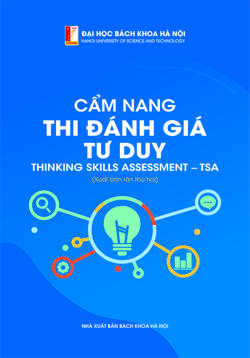
Cẩm nang thi Đánh giá Tư duy
1250 lượt mua
Năm xuất bản sách giấy: | 2011 | Năm xuất bản sách điện tử: | |
Khổ sách: | 16 x 24 | Số trang: | 248 |
Quốc gia: | Ngôn ngữ: | en | |
Mã ISBN: | Mã ISBN Điện tử: | ||
Loại sách: | Sách giấy | Nhà xuất bản: | Nhà Xuất Bản Bách Khoa Hà Nội |
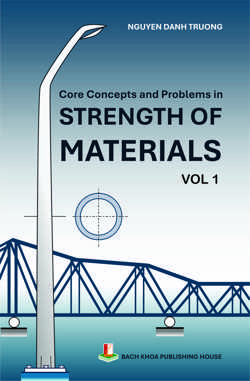
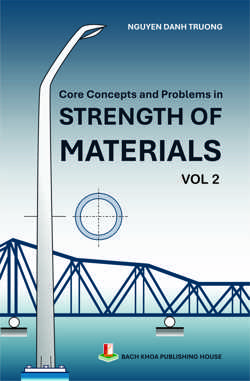
The main objective of the “Strenfth of Materials” course is to develop in Engineering students the ability to analyze a given problem in simple and logical manner and to apply to its solution for design a machine or structure subjected to different loading cases.
This text book “Strength of materials” is designed for students on Mechatronics specialization of Advanced program with 4 credits. It is also be useful for students on Mechanical Engineering to fulfill their knowledge on Streng of Materials, as well as their English on specialization. Author expects that this book will help students who have the passion of learning well this subject to improve their knowledge, as well as to prepare for their Postgraduate Program and future job.
Chapter1: Introduction Concepts of Stress
1.1 Introduction
1.2 Modeling of Structures
1.3 Concepts of Stress
1.4 Stress on an Oblique Plane under Axial loading
1.5 Stress under General loading conditions
1.6 Design Considerations
Chapter 2: Stress Strain. Axial Loadings
2.1 Introduction
2.2 Normal Strain under Axial loading
2.3 Stress- Strain Diagram
2.4 Hooke’s law. Modulus of Elasticity. Poisson’s ratio
2.5 Multi-axial loading. Generalized Hooke’s law
2.6 Statically Indeterminate Problem
2.7 Deformation involved by temperature change
2.8 Stress concentration
Chapter 3: Torsion
3.1 Introduction
3.2 Stress in a shaft
3.3 Deformation in a Circular Shaft
3.4 Stress and deformation in the elastic range
3.5 Statically Indeterminate Shafts
3.6 Design of Transmission Shafts
3.7 Torsion of Noncircular Shafts
3.8 Thin-Walled Hollow Shafts
Chapter 4: Pure bending
4.1 Introduction
4.2 Symmetric members in Pure bending
4.3 Deformation in Pure bending
4.4 Stress and deformation in elastic range
4.5 Bending of members made of several materials
4.6 Eccentric Axial loading in a Plane of Symmetry
4.7 Unsymmetrical bending
4.8 General case of Eccentric Axial loading
Chapter 5: Analysis and design of beam for bending
5.1 Introduction
5.2 Shear and bending moment Diagram
5.3 Relation among Load, Shear force and bending moment
5.4 Design of Prismatic beams for bending
5.5 Using Singularity Functions to Determine Shear force and bending moment
5.6 Non-prismatic Beams
Chapter 6: Transformations of stress and strain
6.1 Introductrion
6.2 Transformation of Plan Stress
6.3 Principal Stresses. Maximum Shearing stress
6.4 Mohr’s Circle for Plane Stress
6.5 General State of Stress. Application of Mohr’s Circle for Three- Dimensional Analysis of Stress
6.6 Transformation of strain. Three-dimensional state of strain
6.7 Failure criteria for ductile and brittle materials
6.8 Stress in Thin-walled pressure vessels
Chapter 7: Principal Stresses under a given loading
7.1 Introduction
7.2 Principal Stress in a Beam
7.3 Design of Transmission Shafts
7.4 Stresses under Combined loadings
Chapter 8: Deflection of beams
8.1 Introdution
8.2 Deformation of beams under Transverse Loading
8.3 Direct determination of Elastic Curve from Load distribution
8.4 Statically Indeterminate Beams
8.5 Using Singularity Function to determine the Slope and Deflection of a Beam
8.6 Moment Area Theorems
Chapter 9: Columns
9.1 Introduction
9.2 Euler’s formula for Pin-Ended Columns
9.3 Extension of Euler’s formula to columns with other end Conditions
9.4 Eccentric loading, the Secant Formula
9.5 Design of Columns under Centric load
9.6 Design of Columns under Eccentric load
Problems Set
Appendix
Reference
Cẩm nang thi Đánh giá Tư duy
1250 lượt mua
Thiết kế IC tương tự
300 lượt mua
99 Bài tập Học thuyết giá trị thặng dư
266 lượt mua
Cẩm nang thi Đánh giá Tư duy
11958 lượt xem

Giải tích I
5115 lượt xem

Giải tích III
3661 lượt xem

Thiết kế IC tương tự
3424 lượt xem
99 Bài tập Học thuyết giá trị thặng dư
2919 lượt xem

Bình luận